
How to choose travertine? Complete buying guide & professional tips
What is travertine?
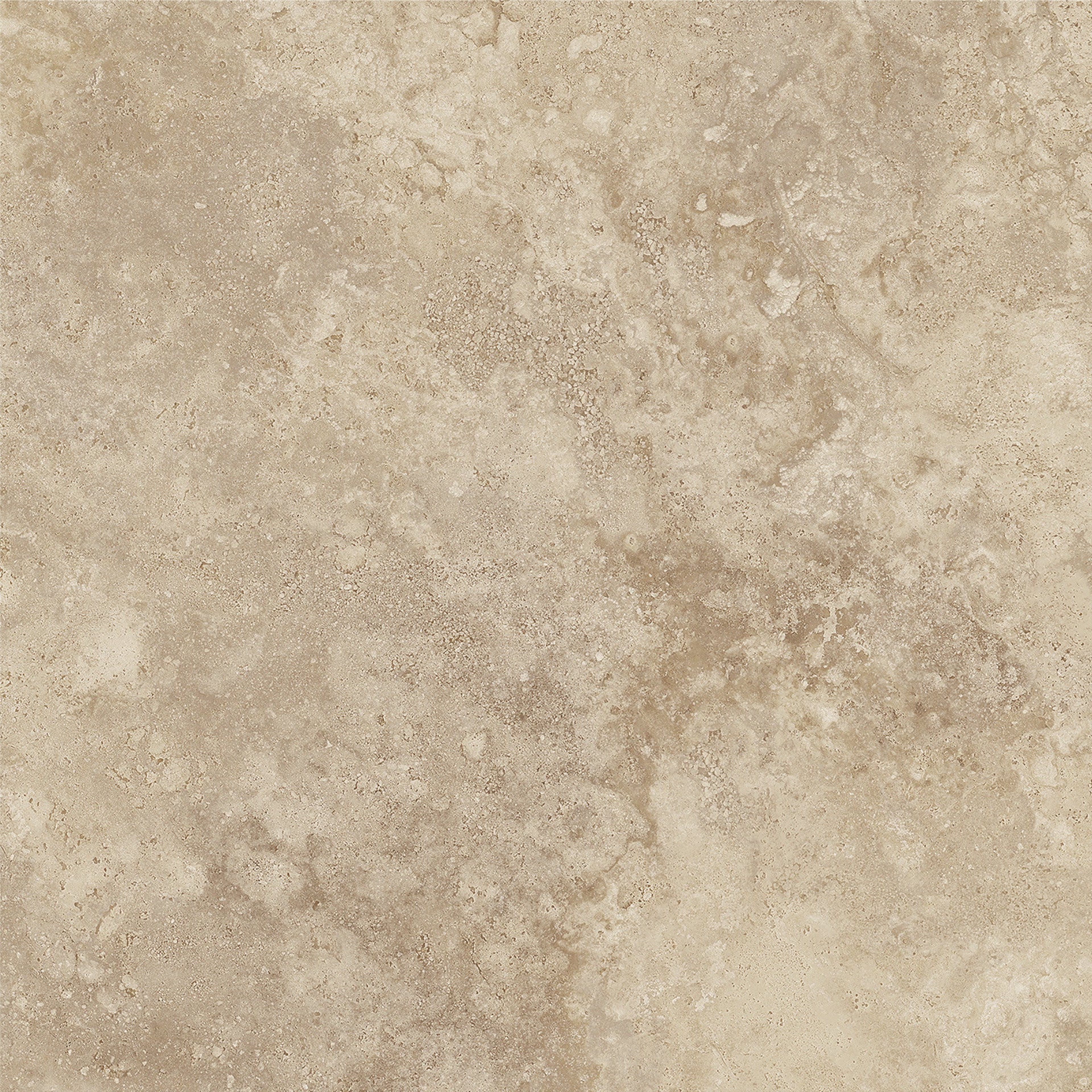
Travertine is a type of natural stone, just like marble or granite for example.
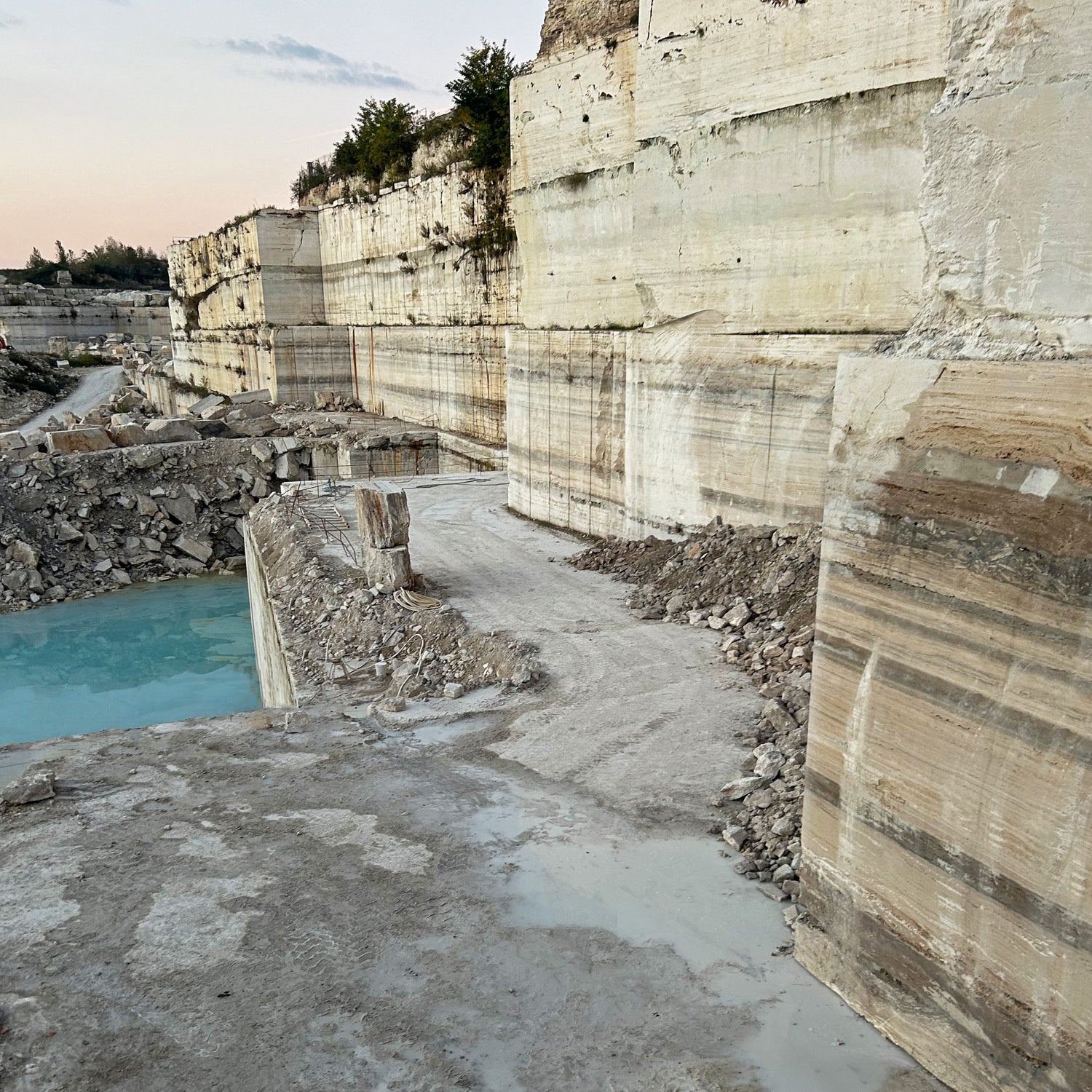
It takes its name from the Latin "lapis tiburtinus," meaning: "Tivoli stone," referring to an Italian town near Rome, known as the most famous and historical travertine quarrying area since antiquity. Used for centuries, this natural stone notably served in the construction of numerous Italian monuments such as the Colosseum, the Trevi Fountain, and St. Peter's Basilica in Rome.
Beyond Italy, travertine deposits exist in other countries:
• France: It is found naturally along waterways in the Jura and Marne (Sézanne travertine). However, due to its tiny quantity, it cannot be exploited for decoration or construction (impossible for tiling or cladding, for example).
• Turkey: Today, most travertine quarries are located in Turkey, making this country the world's leading exporter. Its success is due to its vast resources and incredible geographical deposits, allowing Turkey to offer travertine with excellent value for money. The variety of shades, availability in stock, and diversity of formats make Turkey a benchmark for beige, mix, or silver travertine.
• Italy: It still produces travertine, which is considered the most prestigious in the world. Italian suppliers have chosen to focus on the high-end market by offering only exceptional travertine, without trying to compete with Turkish companies on price. Each block is treated as a unique piece, destined for highly aesthetic projects.

What are the characteristics of Travertine?
As naturally occurring materials, the color of travertine, its finish, and its roughness (or holes) will vary depending on its geographical origin and extraction area. Much like wine: each region gives it a unique personality.
Used both indoors and outdoors, no two travertine tiles are identical; it is all these details that give it its unparalleled charm. Like any natural product, there can be more or less significant disparities from one slab to another.
This natural uniqueness makes each project one-of-a-kind, whether it's a bathroom, an outdoor space, or a wall cladding.
Several elements should therefore be considered when choosing travertine:
Discover our different types of travertine


1. Its color
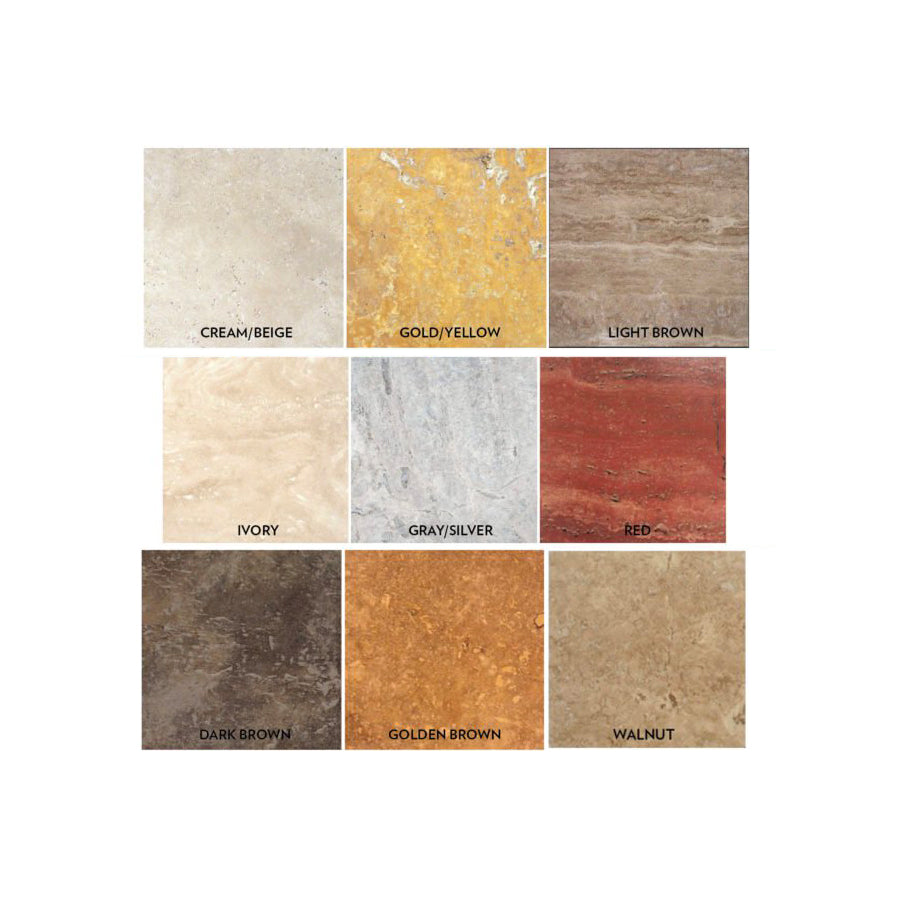
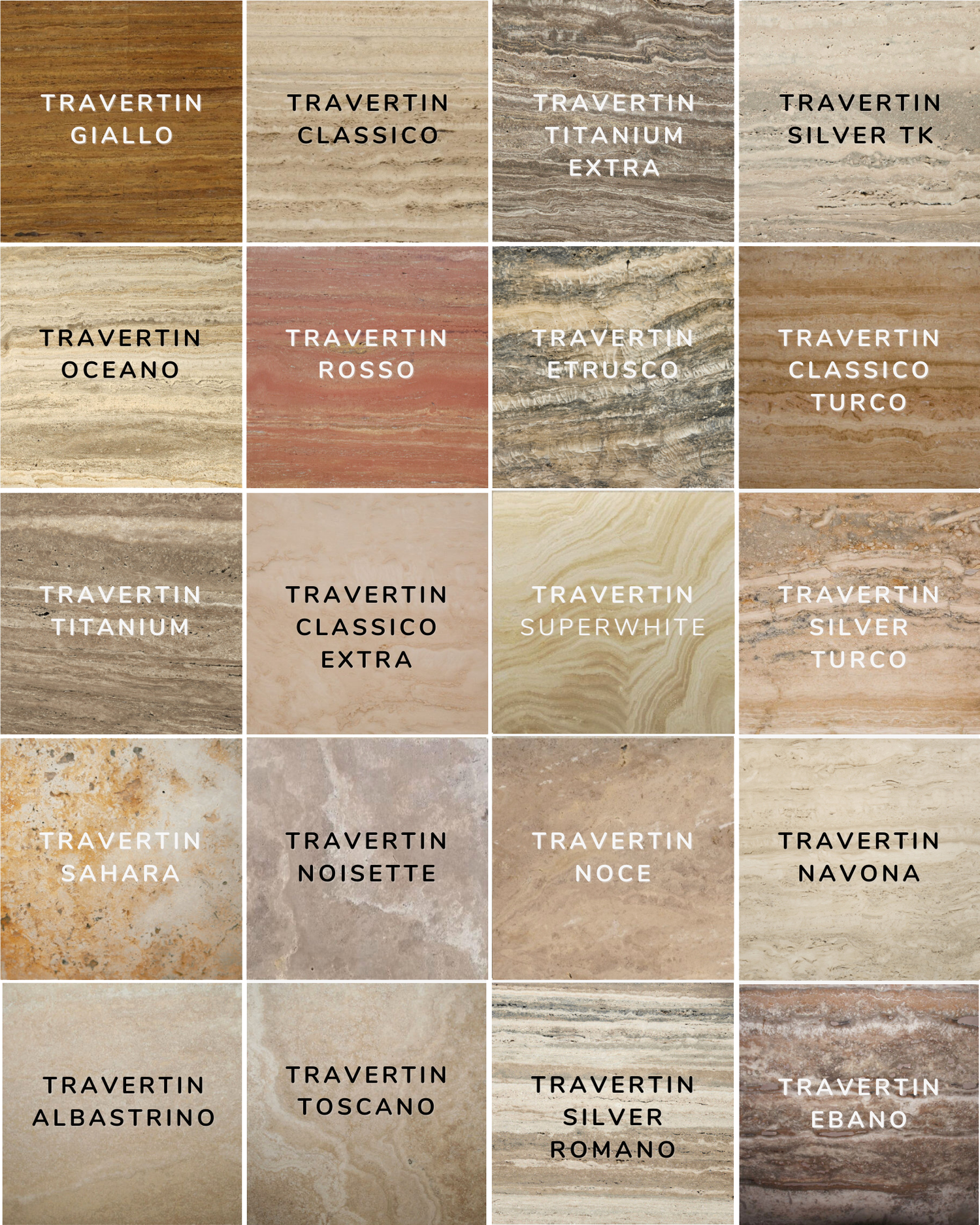
Its color palette is relatively wide: ranging from beige (the most common), brown, yellow, pink, and even silver-gray (also called silver travertine).
Travertine comes in several shades and sorting levels, which influences its appearance and price.
-
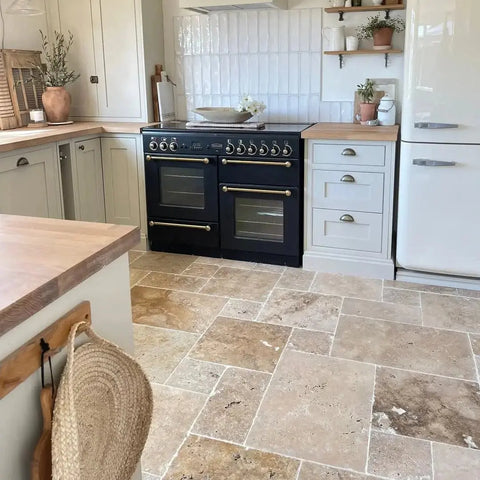
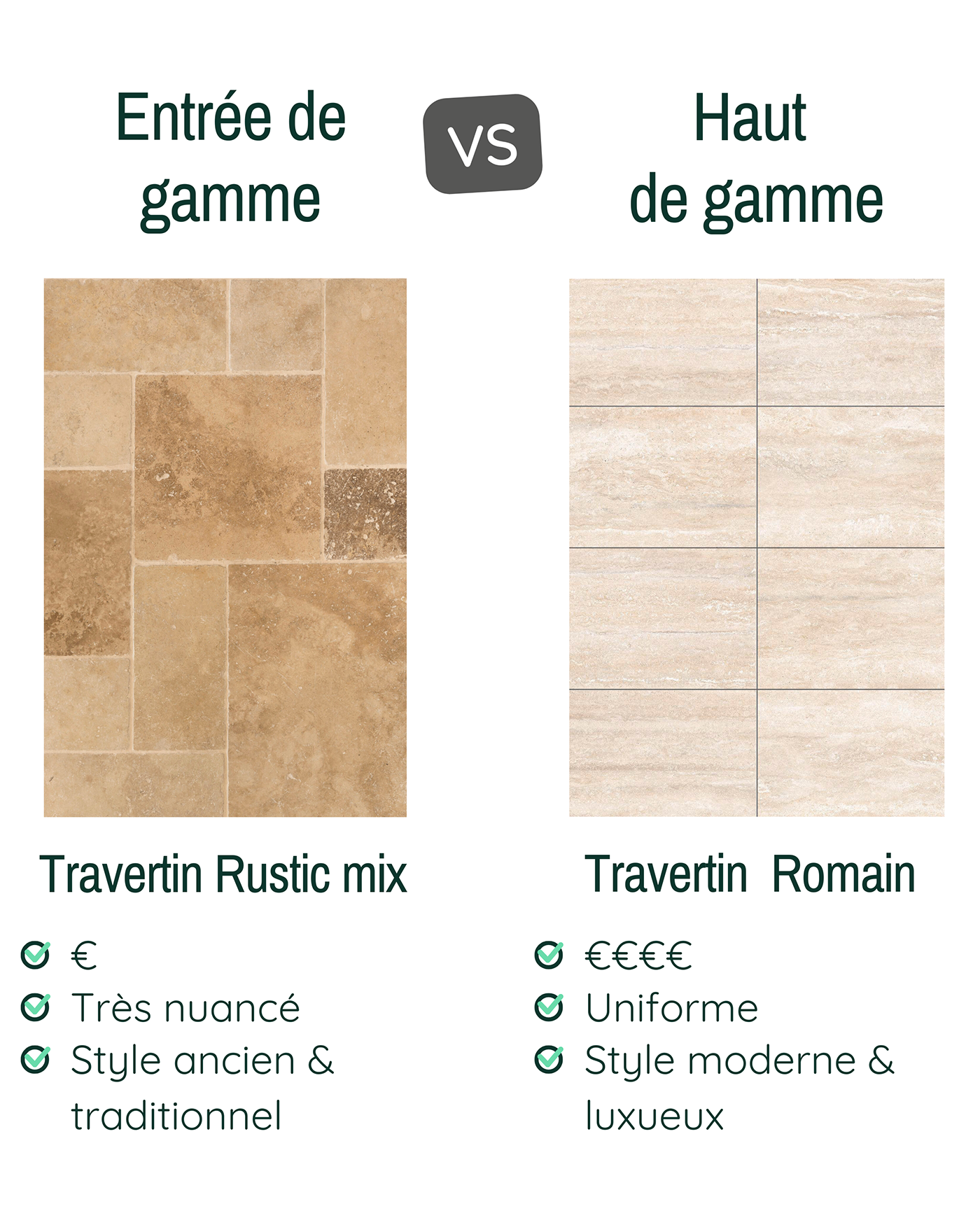
The most affordable travertines are "Mix" or "rustic" travertines. These are stones where no specific sorting is carried out during extraction and cutting. The color nuances are therefore more pronounced, with a mix of brown, beige and sometimes darker shades, giving a natural look but with a pronounced patchwork effect.
-
Some prefer more homogeneous travertines, with fewer marked contrasts. This is where selected travertines come in, like Classic Selection travertine. Here, a sorting is carried out among rustic travertines to eliminate the darkest slabs and obtain a more balanced shade. This preserves the natural and lively side of travertine, but without the large color disparities of Mix travertine.
- Finally, Light travertine is an even finer selection. A more thorough sorting process is carried out to keep only the lightest slabs. The goal is to obtain a more homogeneous color, with a less patchwork and more elegant finish.
This level of sorting directly influences the final appearance, but also the project budget.
💡 However, it is important to remember that travertine remains a natural stone, and absolute color uniformity does not exist. Even with Light travertine, each slab retains its singularity, but the overall effect is more balanced and harmonious thanks to the sorting carried out.
2. Its rough edges
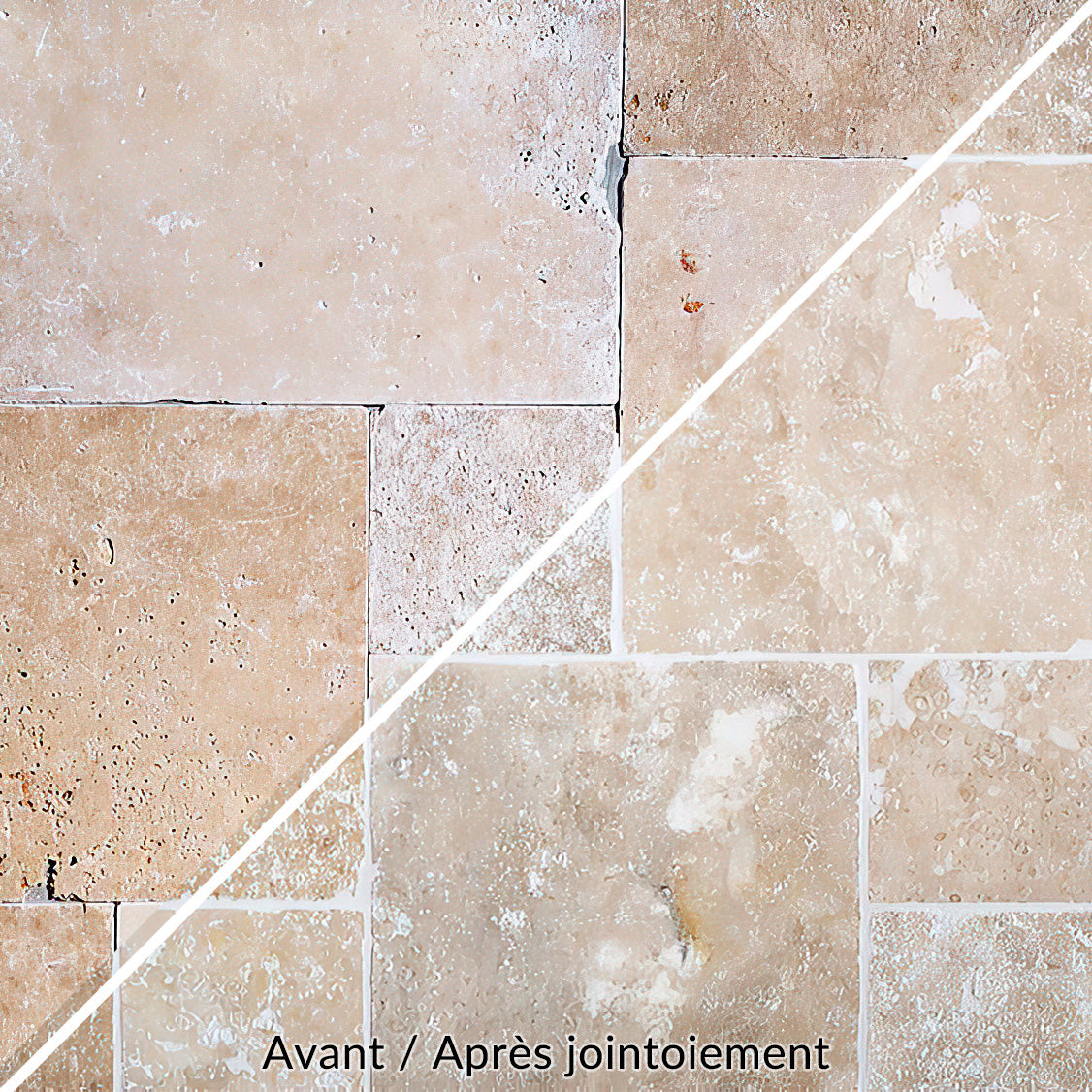
Its trademark: Its many small holes that make it so unique! Travertine has the particularity of having more or less pronounced cavities on its surface, giving it an authentic and very natural appearance.
These cavities, called asperities, are characteristic of travertine and influence both its visual appearance and its maintenance.
Depending on the desired use, these small asperities can be filled to facilitate maintenance, or left as is (preferably for a wall application) to give it a more lively style.
The size and number of holes depend on the quality of the travertine. Poor quality travertine will have larger and more numerous holes, sometimes up to 10 cm in diameter!
These small holes can either be filled directly at the factory (with cement or polyester resin) or by hand, during installation, using a grouting mortar.
In rooms such as a bathroom, a water-repellent treatment is often recommended to facilitate maintenance.
💡 Common misconception: Many people think that travertine is a porous stone because of its many holes… In reality, its porosity is extremely low, barely 1%, compared to 9 to 20% for most Burgundy stones. These cavities have no impact on its absorption.
In addition to being a very hard marble stone, travertine is therefore much less absorbent than one might imagine.
Our Travertine Products
-
 Online Exclusive Mineral SelectionFloor & Wall / Indoor & Outdoor
TRAVERTINE RUSTIC Flooring
Regular price 16,90€ /sqm16,90€ /sqm Sale priceUnit price /sqm per -
 Mineral SelectionCoping stone
TRAVERTINE MIX Pool Coping
Regular price From 13,90€ /pieceFrom 13,90€ /piece Sale priceUnit price /piece per -
Floor & Wall / Indoor & Outdoor
TRAVERTINE MIX Paving
Regular price From 23,90€ /sqmFrom 23,90€ /sqm Sale priceUnit price /sqm per -
Floor & Wall / Indoor & Outdoor
TRAVERTINE CLASSIC Flooring
Regular price From 29,90€ /sqmFrom 29,90€ /sqm Sale priceUnit price /sqm per


3. Its finish (texture)
-
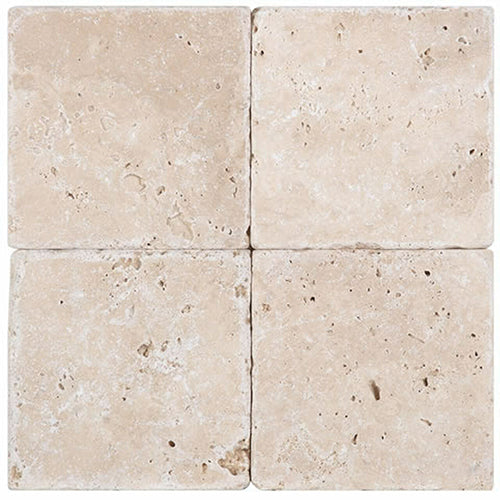
Aged Finish
This finish offers an aged look with slightly broken edges, ideal for rooms with a Mediterranean style or in a country house.
-
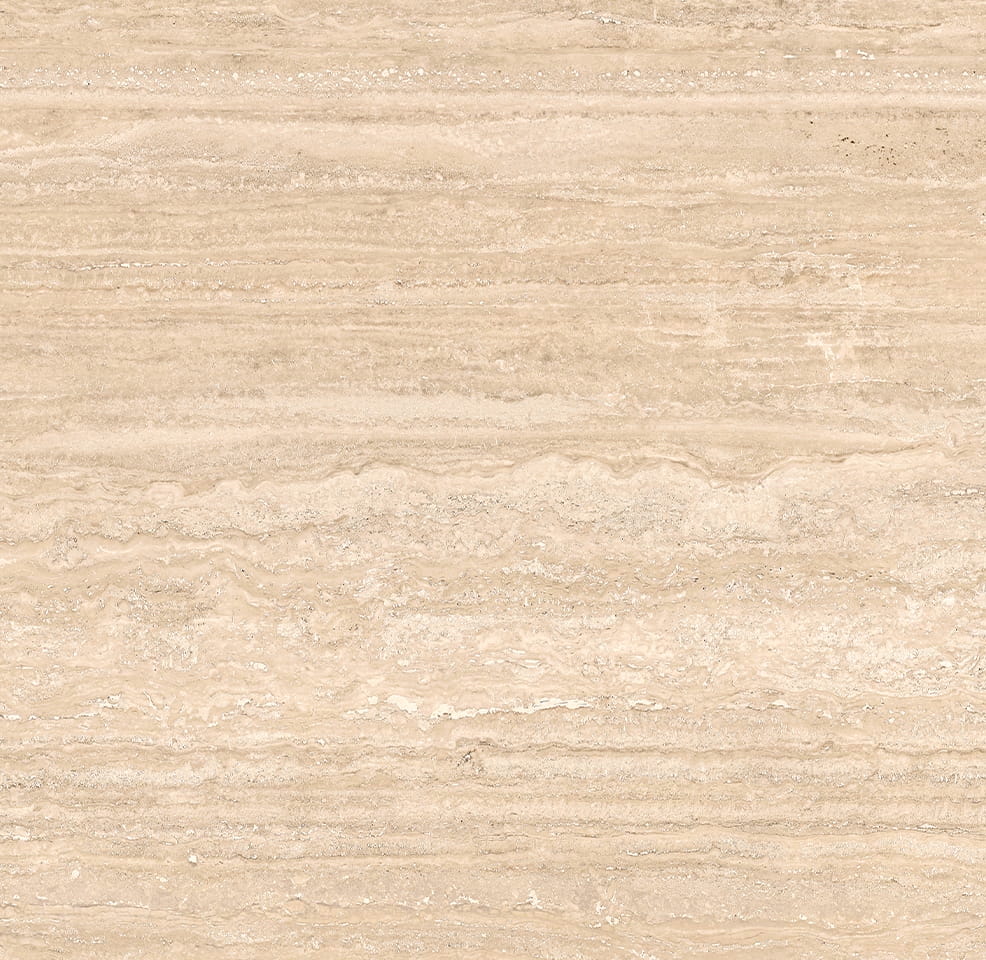
Veined Honed Finish
By cutting the stone along its veins, this finish highlights a pronounced linear pattern. Natural cavities are filled, offering a smooth surface and a modern, structured look, perfect for contemporary spaces. -
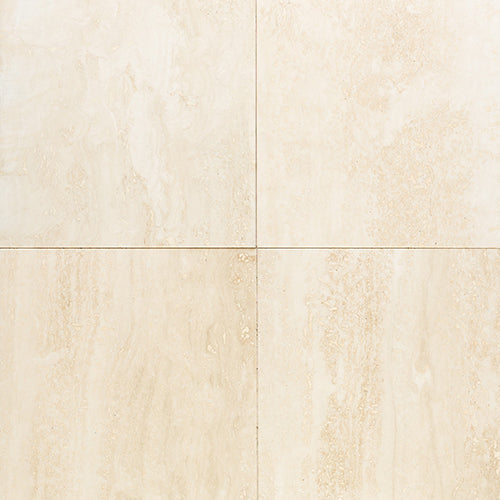
Cloudy Honed Finish
This finish reveals a softer, more uniform appearance, where the natural veins of the travertine fade, giving way to a cloudy, diffuse effect. The natural cavities are filled, offering a matte and even surface, ideal for a clean and soothing ambiance.
-
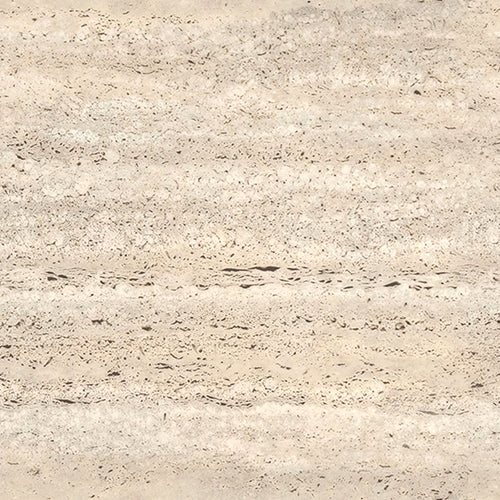
Rough Sawn Finish
The ultimate natural finish, it presents the material in its purest form, without embellishment. Very smooth, this look is preferred in modern decor, typically for wall applications.
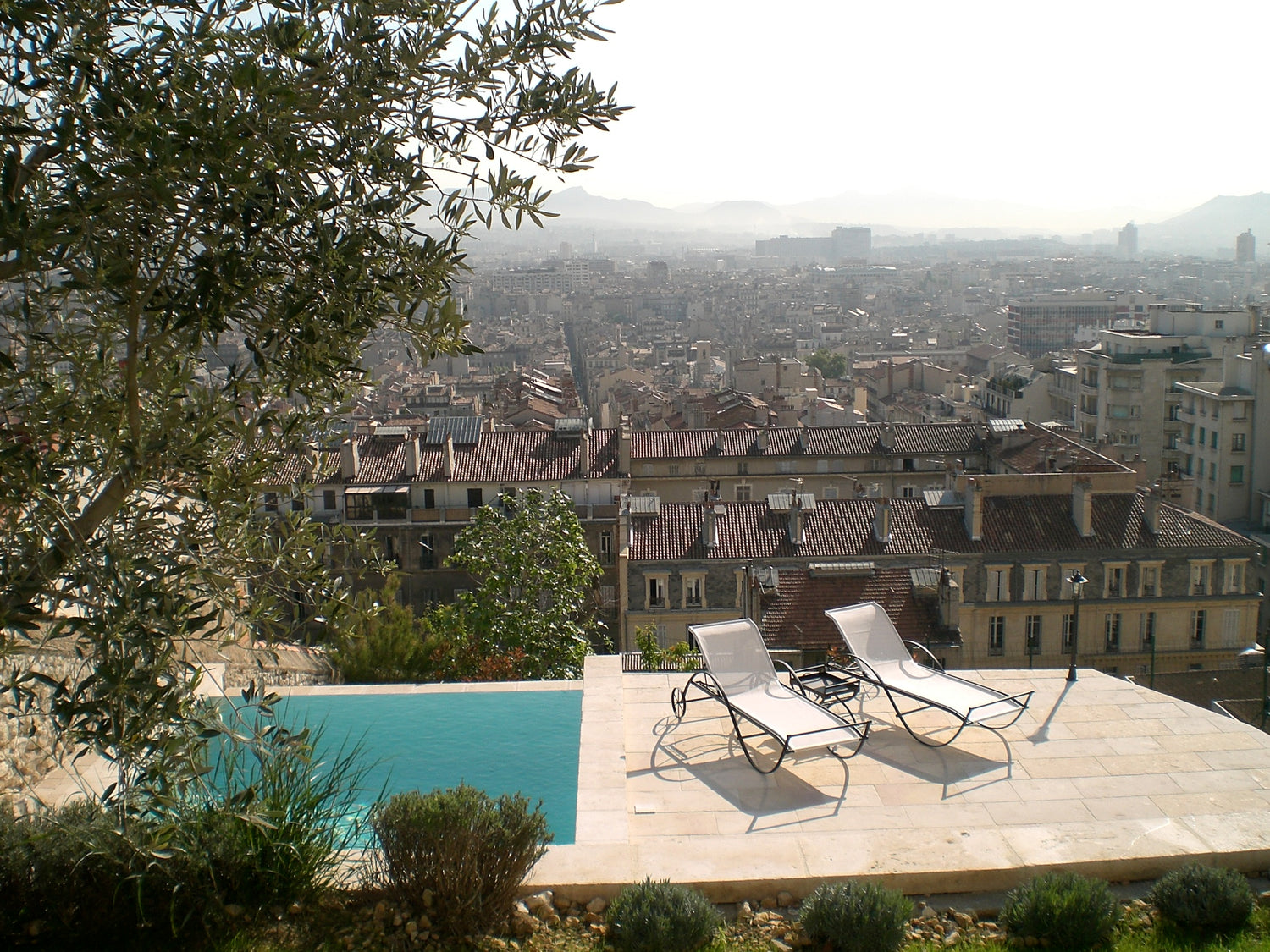
4. Slab thickness and size
The format and thickness of the slabs play a major role in the aesthetics and durability of the project.
The choice of travertine slab thickness varies depending on the installation location:
- Indoors: The most common thicknesses are 1.2 cm to 1.5 cm.
- Outdoors: Thicker tiles are preferred, usually 3 cm. Of course, other factors influence the choice of travertine slab thickness (laying technique, frost exposure, tile format...).
Travertine is available in many standard formats: 60x40 cm, opus romanum, 90x60 cm.
The opus romanum format (also called Opus IV or multi-format) is a mix of slabs in 4 different sizes: 60x40 cm / 40x40 cm / 20x40 / 20x20. It remains the historical preferred format for travertine tiling.
For a more contemporary look, large formats (90/60 or 90/45 cm) are often preferred, particularly for high-end indoor flooring or terraces.
💡 Good to know: It is common to see formats slightly different from classic dimensions. For example, 61 cm instead of 60 cm or 40.6 cm instead of 40 cm. This particularity comes from the fact that the format is based on an inch measurement unit, widely used in the United States, which is one of the largest consumers of travertine. This characteristic, specific to travertine, is rarely found in other types of stone.
5. Cutting direction
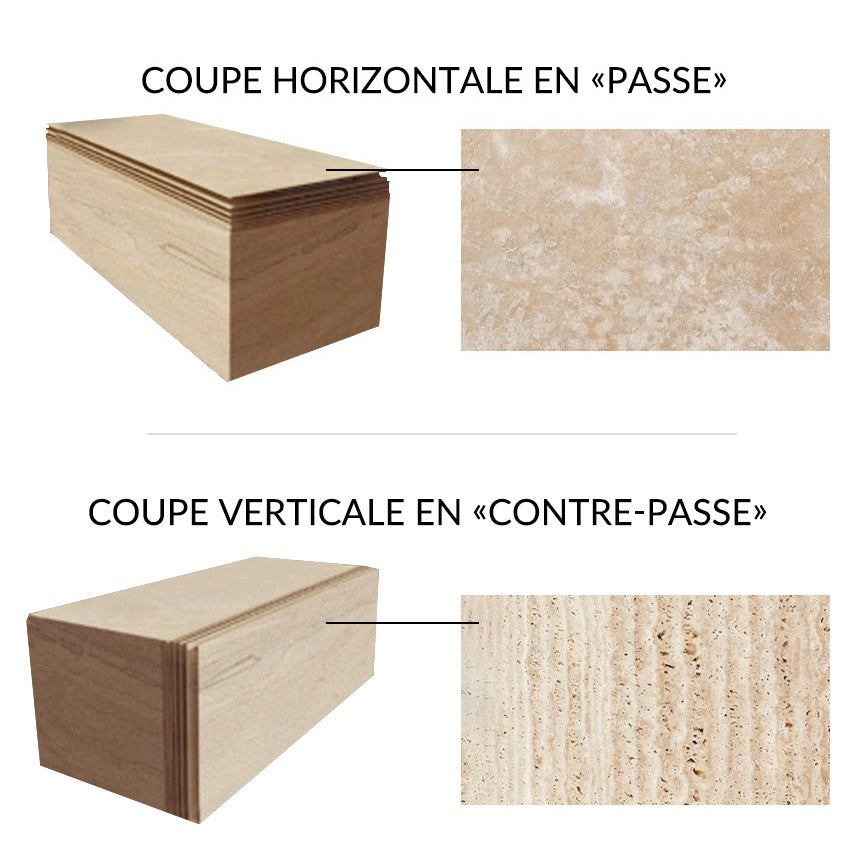
The direction of cut directly influences the visual appearance of travertine and allows for playing with material effects.
Although it is exactly the same stone, blocks of travertine can be cut with or against the grain, which gives a completely different look.
When the stone is cut vertically ("vein cut"), the cut follows the extension of the veins naturally present in the natural stone, thus revealing this very graphic veined appearance throughout its length.
This type of cut, highlighting the natural veins, is particularly popular for projects with high aesthetic requirements, especially for bathroom walls, where one deliberately wants to preserve the raw texture and asperities of the travertine cladding.
Conversely, the horizontal cut is sawn in the opposite direction (called "cross cut"), against the grain. As a result, the veining disappears, giving way to a more uniform and diffuse texture.
Travertine Price and Pitfalls to Avoid
1. Why are there such large price differences?
All the elements mentioned above directly influence the quality and therefore the price of travertine. A rustic mix travertine at €15 per m² is obviously not comparable to a high-end Italian travertine, the price of which can exceed €150 including VAT/m².
The budget therefore varies according to the thickness, the type of finish, the sorting of the tiles, their format and their general appearance.
But beware, there is no official standard defining the different qualities of travertine. It's a jungle out there, and everyone uses the names they want, without any precise framework.
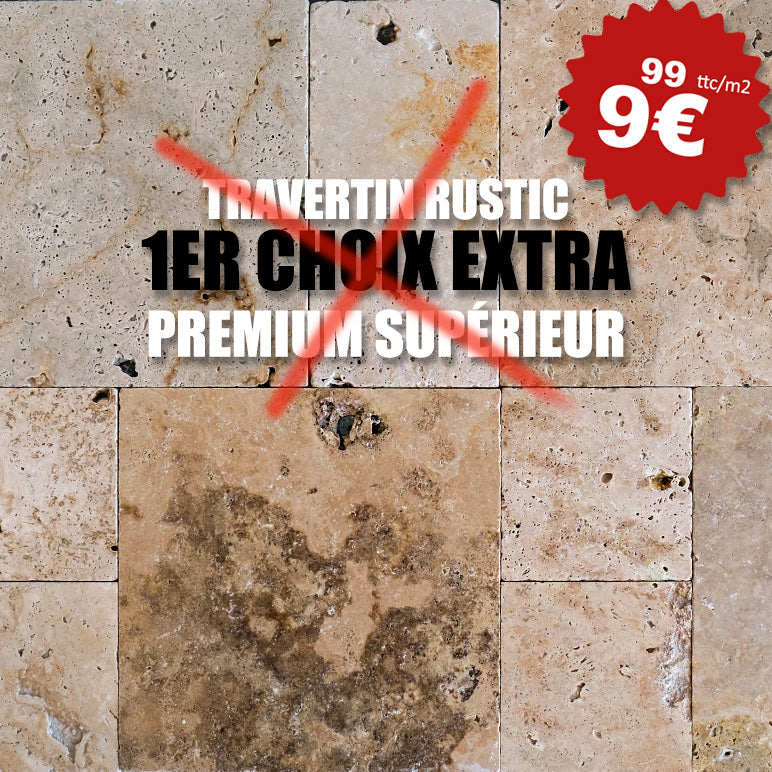
You will see terms such as 1st choice, 2nd choice, 3rd choice, commercial, but also even vaguer variations such as 1st choice light, 1st choice light mix, 1st choice premium, 1st choice premium mix, 1st choice selection, 1st choice superior, premium light selection, extra light rustic choice... So many terms that do not guarantee anything in themselves, since there are no rules governing them.
👉 If you are offered a "superior quality travertine" or a "1st choice" at a ridiculously low price, and it seems too good to be true... it probably is!
2. Beware of misleading names
The problem? Nothing prevents a seller from offering travertine at €11 per m² and calling it "1st choice", even if its quality is very poor.
👉 Travertine close to €10-12 per m2 can hide significant defects, such as overly large holes, approximate calibration, or overly disparate shades.
Before relying on a commercial name, it's better to evaluate the stone according to its finish, appearance, shades, as well as the quantity and size of the holes it presents.
The same quarries we work with offer us even cheaper products, which we could resell for €9.95, €10, or €11 per m². But the quality of these travertines is necessarily much lower: too many holes, too much patchwork, too many irregularities. A very low price often hides visible defects and compromises on selection.
In this market where labels are not regulated, it's better to understand what you're buying rather than relying solely on the displayed price. Travertine is a long-term investment, and quality plays a key role in its appearance and longevity.
3. A multi-faceted material, from rustic to custom-made
Some exceptional travertines, such as the most prestigious Italian blocks, are now sold using a model similar to that of world-renowned marbles: each stone block is unique, and its price varies according to its quality, veining, and rarity. It is therefore impossible to give a fixed price for these exceptional travertines, because each block is different, much like diamonds.
This bespoke approach opens the door to unique projects, adapted to each space and style.
At Minéral, we have chosen to work with quality travertines, whether they are affordable or high-end. We do not seek to denigrate entry-level products, because travertine has its place in a home or garden, regardless of its finish level. One can find a very good travertine for €15, just as there are mediocre travertines for €25 on certain sites, and conversely, exceptional travertines for €400 per m² that fully justify their price.
Thanks to our marble workshop, we are able to offer travertine in all its forms:
✅ In standard tiles for an elegant and durable natural stone floor
✅ Custom-made for specific projects
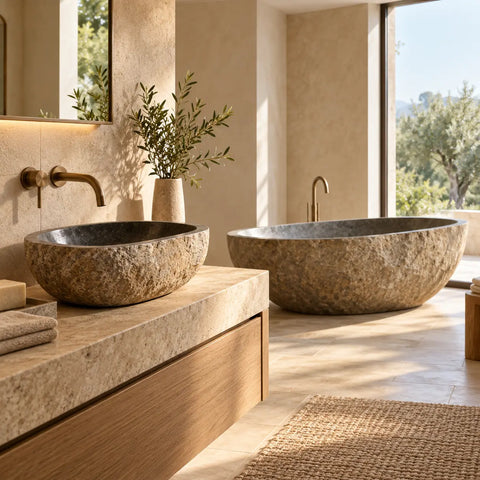
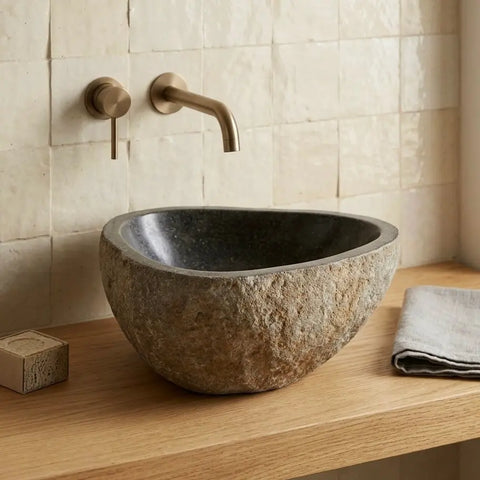
✅ In solid elements to create unique pieces such as basins, shower trays, steps, or countertops
Everything depends on the project, the budget, and the priorities: some will choose a rustic travertine from stock, others will opt for an exclusive custom-made piece.
The essential thing is to fully understand what you are buying to choose a travertine suited to its use and your budget, without relying solely on displayed prices or misleading commercial names.
What are the disadvantages of Travertine?
1. Simple yet appropriate maintenance
Although travertine is an excellent material, it is important to know its limitations to make an informed choice.
Like all natural stone, travertine requires appropriate maintenance, but nothing too demanding.
Simply avoid acidic or abrasive products, such as vinegar and lemon, which can alter its surface, and opt for mild cleaners, such as Marseille soap or black soap.
Water-repellent treatment is recommended to protect sensitive areas such as kitchens, bathrooms, or exposed terraces.
For optimal maintenance, the use of specialized products, such as those from the Lithofin brand, a benchmark in natural stone, is recommended.

2. Recommended protection in certain areas
Outdoors, travertine naturally resists stains thanks to the sun's UV rays, which help them fade over time. However, in high-traffic areas (barbecue, bar, under a fruit tree), a water-repellent treatment can limit liquid absorption and facilitate cleaning. The MN Fleckstop, an oil and water repellent, specifically protects against water, oil, grease, and other everyday stains.
🛑 Don't worry! These precautions do not only apply to travertine, but to all natural stones. And even if a stain appears, there are always suitable solutions, just like for clothes with specific stain removers.
Nothing dramatic! Especially since travertine develops a patina over time, and any small marks will naturally blend into its authentic charm.

What are the benefits of Travertine?
1. Durable and hard-wearing
Yes, travertine is frost-resistant!
Travertine has been used for centuries in building construction. As long as it is well-maintained, quality travertine will stand the test of time without any problems.
Beyond its aesthetics, travertine is appreciated for its robustness and versatility, both indoors and outdoors.
Very robust and renowned for its long lifespan, this material withstands the wear and tear of time and will gain charm as it patinas over the years.
A very hard material: it is not afraid of impacts, cracks, or scratches. It is also highly valued for its ability to withstand temperature fluctuations, coping equally well with frost and high heat.
It is an excellent choice for patio slabs, pool coping, or an interior floor subject to heavy traffic.
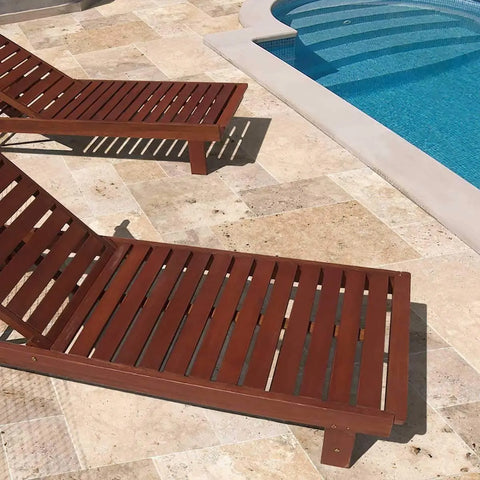
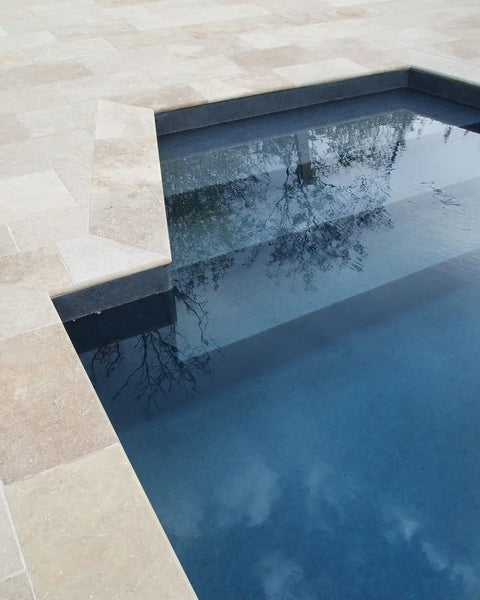
By choosing the right adapted floor finish, travertine is non-slip, making it an ideal option for wet areas like pool surrounds and coping.

2. Undeniable aesthetic qualities
Travertine is the ideal covering for both your indoor and outdoor spaces. It will instantly add a refined and lively touch to your living areas. Like other limestones, its warm and natural shades will cleverly combine with various beige styles: modern, Mediterranean, country house, etc.
Its aged or softened appearance adapts equally well to a contemporary bathroom or a rustic living room.
These details and choices make this product a true must-have for your natural stone outdoor space. Its wide range of colors will allow you to find the perfect fit.
Specially selected for outdoor applications, this covering will be ideal:
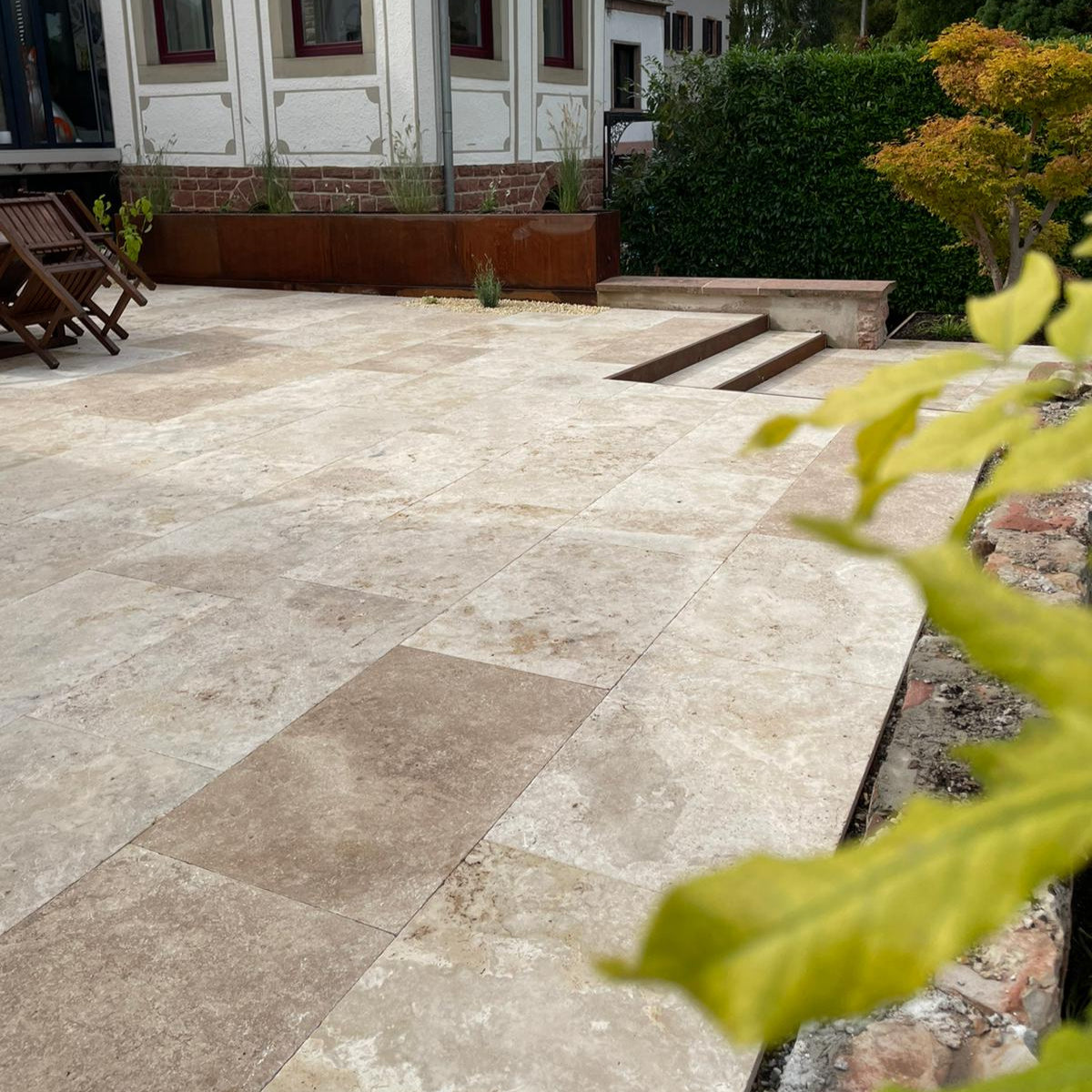
- On terraces
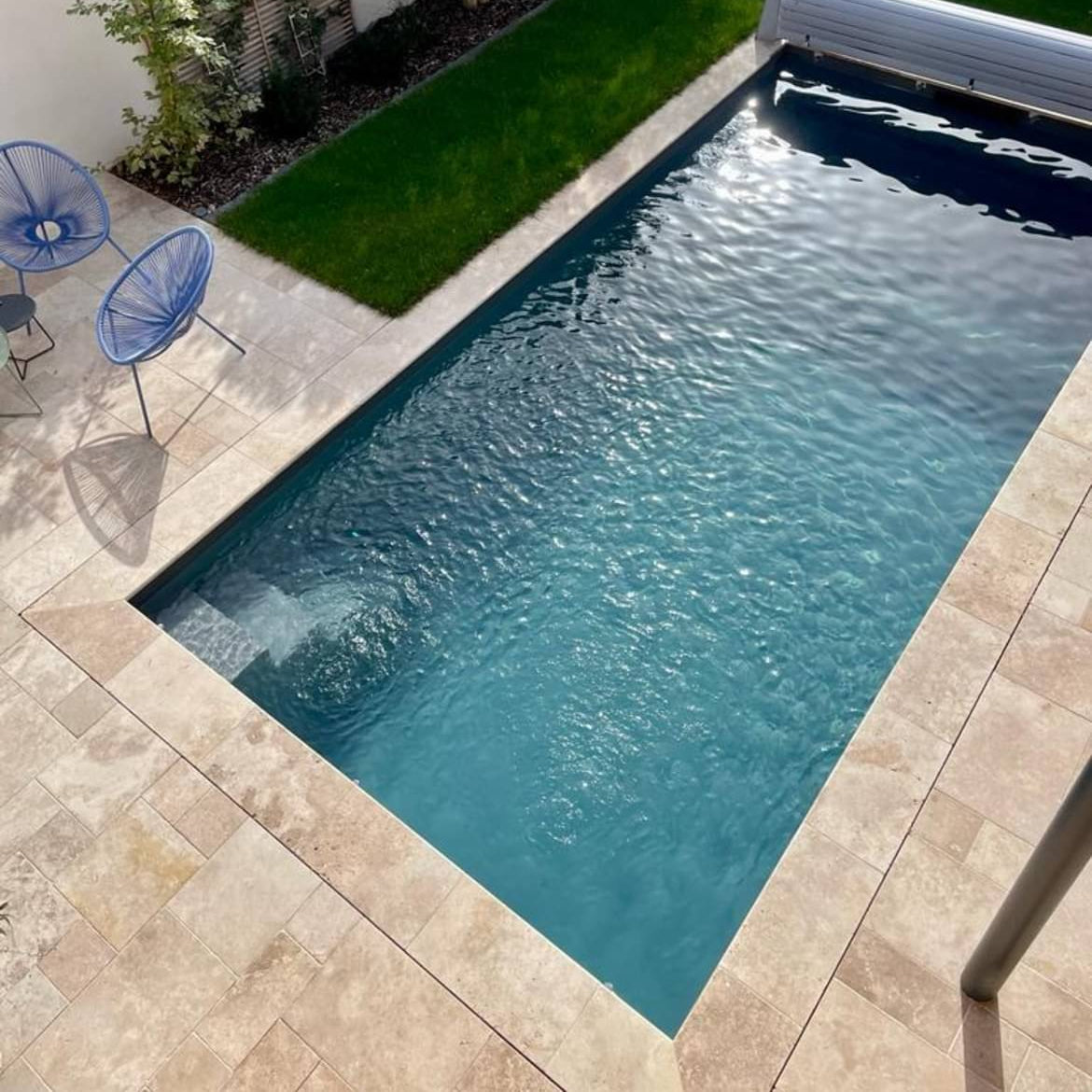
- Around a pool (as pool coping or outdoor paving)
- As pavers for courtyards, driveways, and other trafficable areas
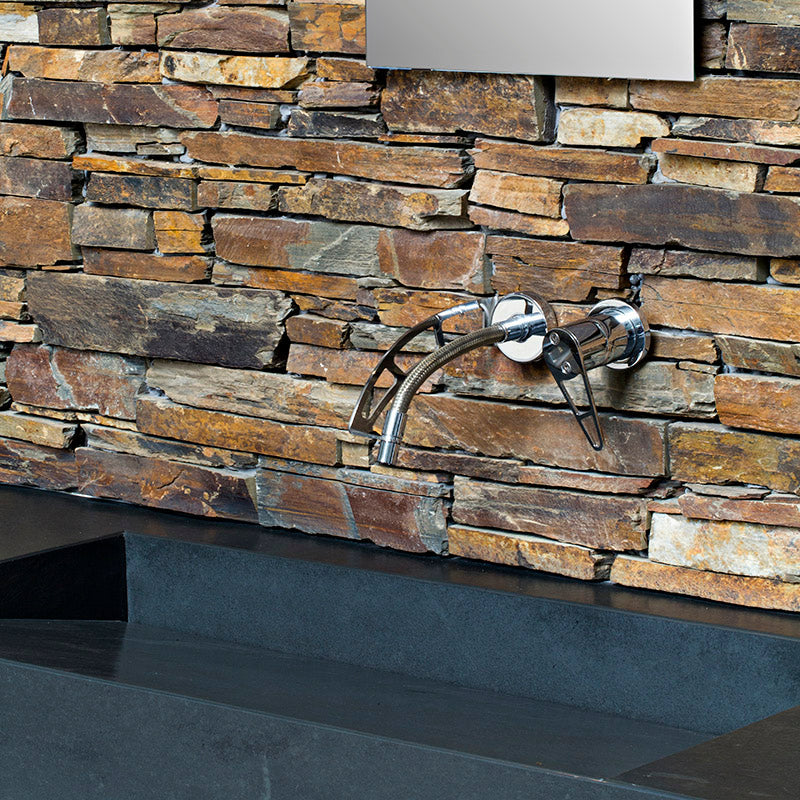
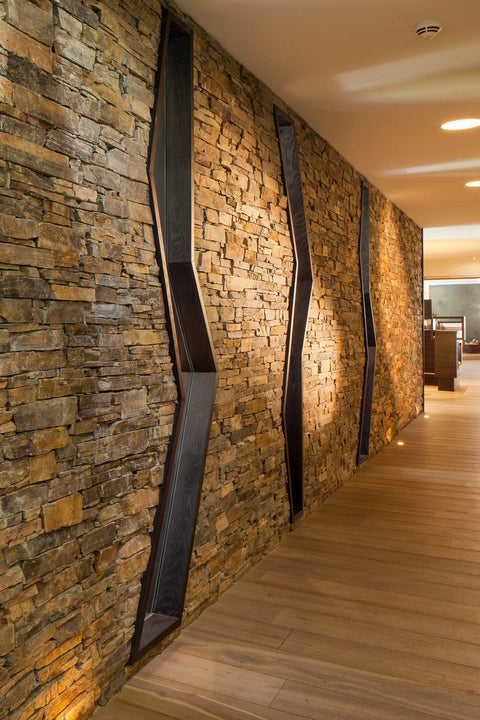
- For wall decoration (as rubble stone or cladding stone)
3. Environmentally friendly
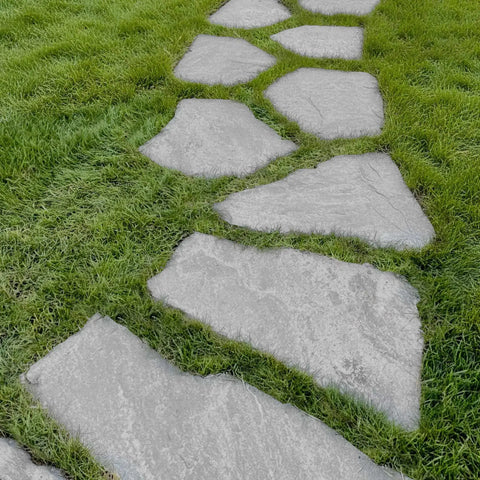
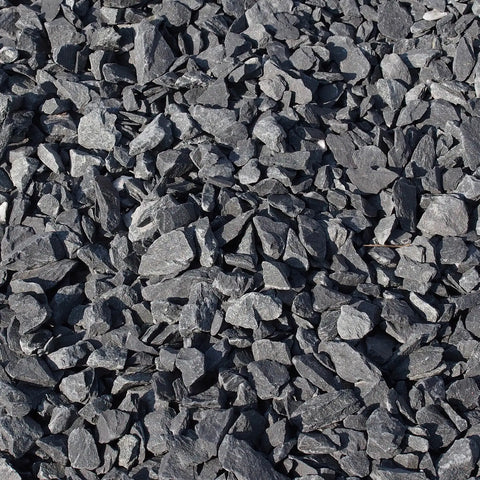
Naturally present in the environment, travertine requires no heavy industrial processing to be exploited. Each block of stone is used in its entirety, and even offcuts are repurposed to create complementary products such as crushed stone, mosaics, decorative rocks, or stepping stones.
Its lifecycle is exceptionally long: rather than replacing old paving, it can simply be sanded to restore its original shine. This material, free of harmful substances, is extracted without the use of chemicals and can, if necessary, be fully recycled.
A responsible choice for sustainable projects, both in construction and landscaping.
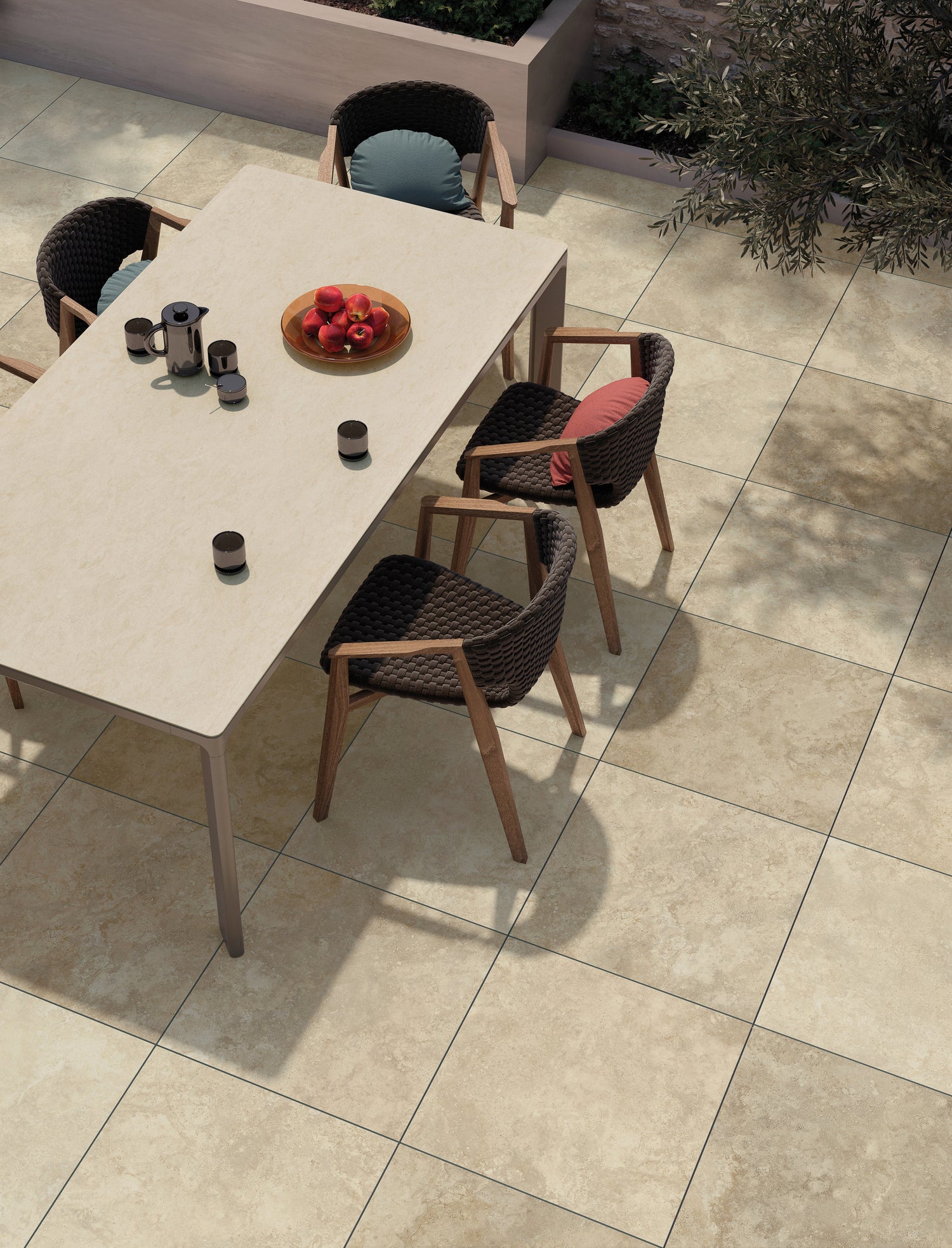
Travertine-look tiles: a modern alternative
1. Technical advantages of travertine-effect tiles
Given the success of natural travertine, travertine-look porcelain tiles offer a technical and aesthetic solution for certain projects.
Natural travertine is a prime choice for an authentic covering, but today there's a very popular alternative: travertine-look porcelain tiles. Made from porcelain stoneware, these tiles faithfully reproduce the look of travertine while offering additional technical advantages:
✅ XXL formats available: Unlike natural travertine slabs which have limited dimensions, porcelain allows for impressive large formats up to 160x320 cm, ideal for kitchen countertops, islands, or vast wall surfaces.
✅ Reduced thicknesses: Porcelain tiles are available in thin thicknesses (6 to 9 mm), making them easier to use for wall coverings, furniture cladding, or renovation without major work.
✅ Minimal maintenance and increased resistance: Unlike natural travertine, which may require filling cavities and a waterproofing treatment, porcelain is completely non-porous, stain-resistant, and highly resistant to chemicals.
✅ Color homogeneity: While natural travertine varies from slab to slab, porcelain tiles offer either perfect uniformity or controlled variation of shades. This can be an asset in modern and minimalist projects.
These technical advantages make porcelain particularly suitable for certain uses such as kitchens, bathrooms, or as outdoor tiles.
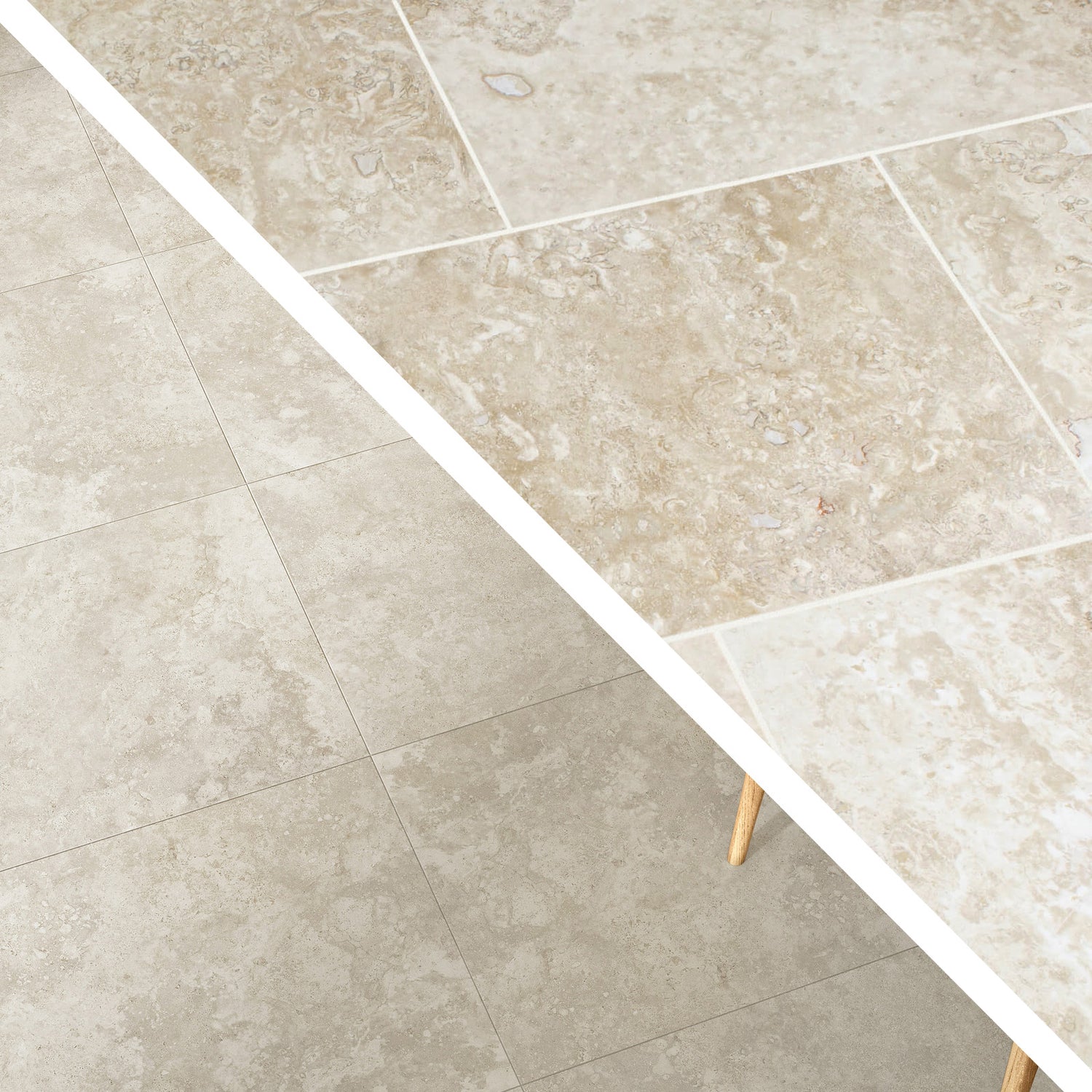
2. Natural travertine: unparalleled authenticity
Despite these many advantages, travertine purists will always opt for natural stone, which remains the original and inimitable version. Where ceramic excels in large formats and homogeneity, natural travertine allows for custom-made, solid creations.
👉 A key difference: With natural travertine, it's possible to sculpt massive elements such as basins, sinks, stair treads, or bathtubs, playing with curves, rounded edges, and thickness. Ceramic, on the other hand, only allows for assemblies with sharp edges and stricter finishes.
Finally, ceramic manufacturers are now trying to best reproduce the details of natural travertine, by adding imitated holes, slightly chipped edges, or even wear effects... But despite these advances, there's no comparison: natural stone remains unique in its appearance and feel.
Thus, ceramic and travertine are not competitors, but complementary. Travertine-look ceramic is ideal for those seeking easy maintenance and XXL formats, while natural travertine remains the choice for lovers of authenticity and character, with endless creative possibilities.
Conclusion
Discover our travertine paving
-
Floor / Outdoor
TRAVERTINE LIGHT CROSS Stone-Effect Outdoor Tiles - 2 cm
Regular price From 49,50€ /sqmFrom 49,50€ /sqm Sale priceUnit price /sqm per -
Floor / Exterior
TRAVERTINE RUSTIC Stone-Effect Outdoor Tiles - 2 cm
Regular price From 41,50€ /sqmFrom 41,50€ /sqm Sale priceUnit price /sqm per -
Floor / Exterior
TRAVERTINE PHILLY Paving
Regular price From 99,00€ /sqmFrom 99,00€ /sqm Sale priceUnit price /sqm per -
 Upon quotation


Our Commitments