
Choosing Your Pavers
Natural stone pavers are used outdoors for paving driveways, patios, borders, and mowing strips, but primarily for driveways. As the first material in our history to be used for roadways, it remains in people's minds a great classic in environmental design.
However, to fully enjoy them, it's important to understand how to lay, maintain, and clean pavers. In this article, we will answer all common questions about natural stone pavers, from installation to sealing and maintenance.
Natural stone pavers are a popular option for driveways, patios, and outdoor spaces. They offer an authentic and natural aesthetic that blends perfectly with all garden styles. However, to fully enjoy them, it is important to understand how to lay, maintain, and clean pavers. In this article, we will answer all common questions about natural stone pavers, from installation to sealing to maintenance.
1. What is a paver?
The stone paver, originally intended for paving roads, must by definition have a certain thickness that allows it, when blocked against each other, not to disintegrate. Its second specificity is a small format, even if this depends on the material or its stress; the largest do not exceed 20/20 cm for squares and 30/20 for rectangles. Depending on the manufacturing process, its thickness can be regular if sawn or have a large variation of approximately 2 to 3 cm if split.
It comes in a multitude of colors, textures and formats. Renowned for its excellent durability, it adapts to all types of architecture and remains absolutely timeless.
A paver is a small unit of stone, concrete or terracotta flooring. Natural stone pavers are particularly popular for their aesthetics and durability. They are commonly used for driveways, patios, terraces and gardens.
2. Different types of pavers
Raw pavers
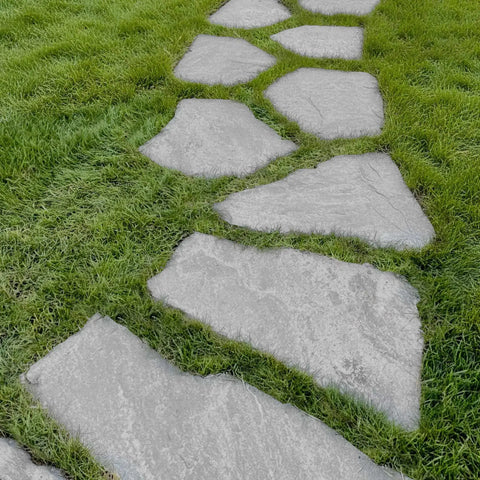
Raw pavers have an irregular surface that gives them an authentic and rustic look. They are ideal for traditional layouts and offer excellent grip, even in wet weather.
Irregular-edged pavers
This type of paver, often hand-cut, has irregular contours that accentuate its natural character. They are perfect for rustic outdoor spaces and the renovation of ancient sites.
Straight-edged pavers
Straight-edged pavers offer a more modern and uniform finish. They make installation easier and allow for a more contemporary look, suitable for driveways and designer patios.
Tomettes (terracotta tiles)
Tomettes, often made of terracotta or natural stone, are distinguished by their flat format and warm color. They are particularly popular for patios and Mediterranean spaces.
Old pavers
Old pavers recovered from ancient buildings or roads bring unique charm and incomparable authenticity. Their natural patina and irregularities make them highly sought-after materials for renovation projects.
3. What size should a paver be?
A paver should have a maximum size of 20 x 20 cm or 20 x 30 cm. Beyond that, it's considered a slab. It's this small format, combined with a significant thickness (5, 6, 8, 10 or 12 cm), that guarantees the product's stability and resistance.
Classic granite formats are:
10 x 10 cm for sawn granite pavers,
8 x 10 cm for split granite pavers with natural faces.
For a traditional arch or fan pattern installation, only split formats with variable dimensions are suitable.
Natural stone pavers come in a wide range of sizes, from 5 x 5 cm to 60 x 60 cm. The choice of size will depend on the intended use and desired aesthetic:
Small formats: ideal for pathways,
Large formats: more suited for patios and terraces.
5. What height should a paver be?
The thickness of a natural stone paver primarily depends on its use:
Pedestrian: 5 cm minimum,
Occasional vehicular traffic (e.g., occasional light vehicles): 6 to 7 cm,
Regular light vehicular traffic: 8 cm,
Heavy vehicular traffic: 10 to 12 cm.
It also depends on its resistance to pressure, the format, and the type of installation. For example, a hard limestone paver of 15 x 15 cm laid on mortar may be sufficient with 5 cm thickness for light vehicular use. However, for a 20 x 20 cm paver laid on aggregate, a thickness of 8 cm will be necessary.
It is therefore essential to consult your distributor to choose the correct height according to the project.
7. How to calculate the number of pavers per m²?
At Minéral, the number of pavers per m² is already indicated on the price lists. Grout lines are automatically deducted, thus avoiding costly excess material. For example, for 10 x 10 cm pavers with a 1 cm grout line, the grout represents more than 15% of the surface area.
If you wish to calculate it yourself:
Formula:
Number of pavers = Area to cover (m²) / Area of one paver (m²)
Example:
Paver size 30 x 30 cm (i.e., 0.09 m² per paver)
Area to cover: 10 m²
10 / 0.09 = 112 pavers (rounded)
Tip: Plan for 5 to 10% additional pavers for cuts and adjustments.
10. What is the price of a paver?
The price of natural stone pavers depends on several criteria:
Size, Color, Quality, Stone origin
In general, natural stone pavers are more expensive than concrete pavers, but they offer superior durability and a more attractive aesthetic appearance.
Price range:
Natural stone pavers range on average from 50 to 150 euros per m².
Tip:
The price can also fluctuate depending on the type of stone, the chosen finish, and the supplier.